Personal Relationships

Find words for what you need

  • Clarify needs and boundaries
  • Adapt an expression draft
  • Observe for 7 or 14 days

Only your own chart is needed

Pricing and availability are confirmed when you open this page.

Private web report + PDF

View sample
Sample

Breaking the Cycle of Holding Back Until I Snap

Your question
We have been dating for almost a year, and whenever plans change last minute or replies slow down, I pretend it is totally fine. By the weekend, that bottled-up frustration explodes over something tiny and turns into a cold war. I hate draining myself and freezing the mood, yet I freeze up in the moment.

What changes the picture

What hurts isn't having needs—it's disguising them until they erupt

You are not trying to make a small change into a big argument. You are leaving an easy-to-name need until you feel most hurt. Your own description—saying it is fine, then bringing it up later—gives you somewhere to start. Ask for a clear update while the change is happening, so disappointment does not have to arrive as a cold shoulder.

From the chart to a useful next step
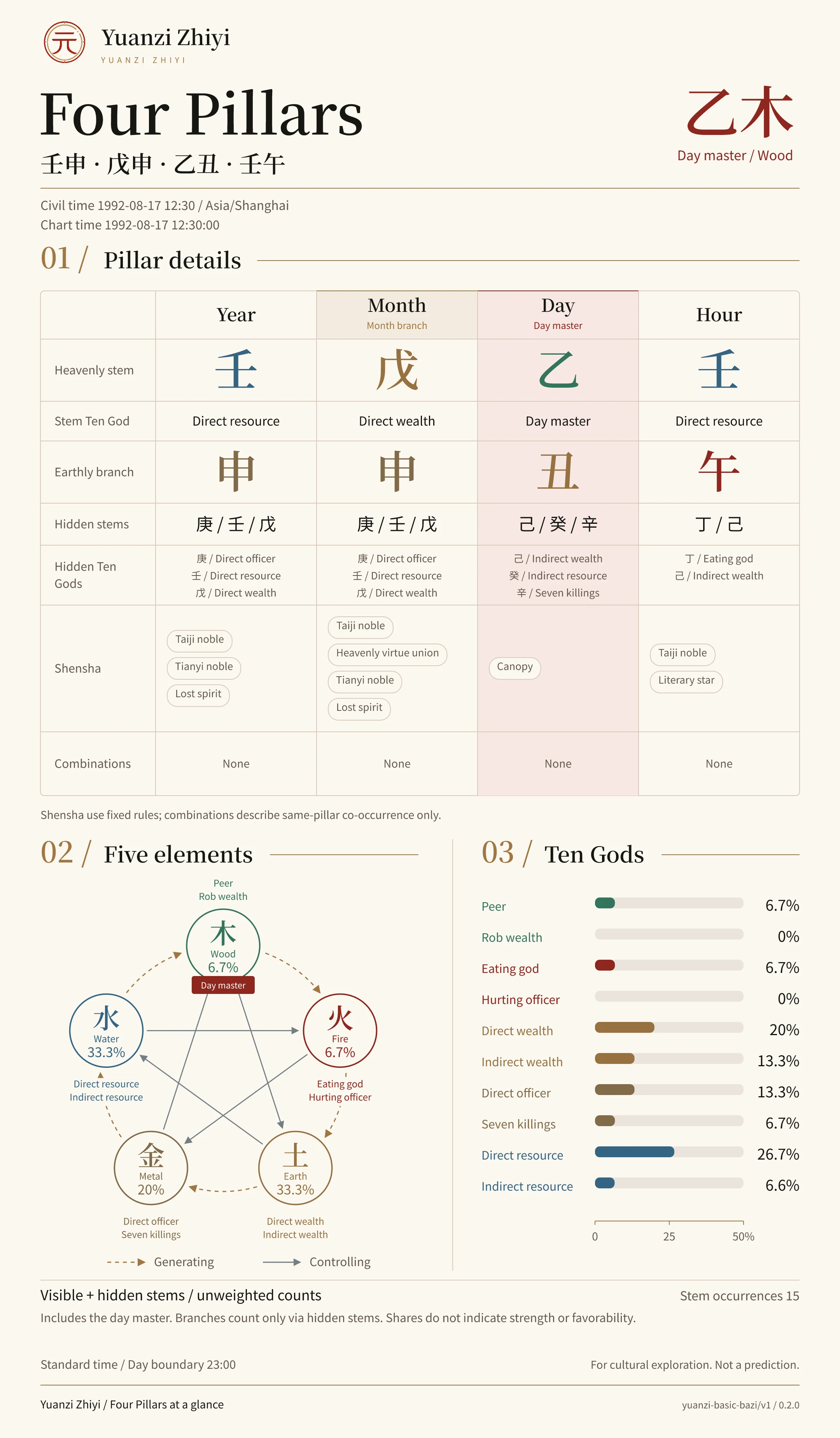
MCP chart image: Ren-Shen, Wu-Shen, Yi-Chou, Ren-Wu. Four Pillars table, Five-element composition, Ten Gods shares
MCP chart imageView full-size image
  1. Four Pillars table

    Yi Wood · Ren Resource · Wu Wealth

    Yi Wood and visible Ren Direct resource offer a reflection lens around processing and understanding. Compare that with your own account of saying “fine” and raising it later; practise one earlier request.

  2. Five-element composition

    Earth 33.3% · Water 33.3%

    Earth and Water each represent 33.3% of equally counted stems, not an emotional score. Return to the actual trigger: check your own plans before agreeing to a last-minute change.

  3. Ten Gods shares

    Direct resource 26.7% · Direct wealth 20%

    Direct resource accounts for 26.7%. Use “thinking it through before speaking” as a question, not a label. Send one workable rescheduling request before waiting for every feeling to settle.

Chart clues, checked against your experience

This example has a Yi Wood Day Master with Ren Direct Resource visible. The reading uses the theme of taking things in and processing them as a starting point, then checks it against your account of holding back and returning to the issue later. The useful next step is earlier expression, rather than a personality label.

Personal Boundary and De-escalation Signal

When old grievances start crowding in, set a personal boundary against rehashing past arguments on the spot. Ask for thirty quiet minutes to settle before talking so frustration does not turn into icy testing.

Put it into practice

A Ready-to-Send Text When Plans Change

I do feel a little disappointed about rescheduling last minute since I cleared tonight for us. Go handle what came up first, and let's pick a firm makeup evening before bed tonight so I know what to count on.
  1. Replace the Reflexive 'No Worries' Reply

    Next time plans shift unexpectedly, pause three minutes before texting back. Skip the automatic 'it's fine' and share one honest feeling paired with a concrete request to lock in a new time that same day.

  2. 14-Day Self-Observation Log

    For two weeks, jot down each moment you feel tempted to swallow annoyance: note the direct request you sent instead and how quickly your tension dropped, reviewing only your own clarity without grading your partner.

What you take away

  • Personal emotional need and trigger loop breakdown
  • Non-blaming expression cards for sensitive moments
  • Personal boundary guide and 14-day observation log
What to prepare

Your own chart and one relationship concern. No birth details from the other person are needed. Single people can use it too; keep an unknown birth time unknown.

Report and use

Receive needs and boundaries, an expression draft and a short observation plan in a private web report and PDF. It does not determine another person’s thoughts. If there are threats or control, seek practical safety support first.
Two-person relationship reading

Understand differences. Agree on daily life.

Two-person relationship reading

Two charts, with permission from both people

Sample

Planner Meets Free Spirit Before Moving In Together

Your question
We have dated for two years, plan to move in together soon, and both consented to compare our birth charts. Things feel steady until shared expenses or weekend plans come up: I want clear monthly budgets, while my partner feels suffocated by rigid home schedules. How can we agree on house rhythms warmly before unpacking?

What changes the picture

One of you finds safety in structure; the other recharges through breathing room

The sticking point is not who is better at living together. You have not yet agreed which decisions belong to both of you and where each person keeps room to breathe. Set the need for planning alongside the need for flexibility: settle shared costs first, then give the weekend both shared time and open space.

From the chart to a useful next step

First fictional chart: Ren-Shen, Wu-Shen, Yi-Chou, Ren-Wu. Four Pillars table, Five-element composition, Ten Gods shares
First fictional chartView full-size image
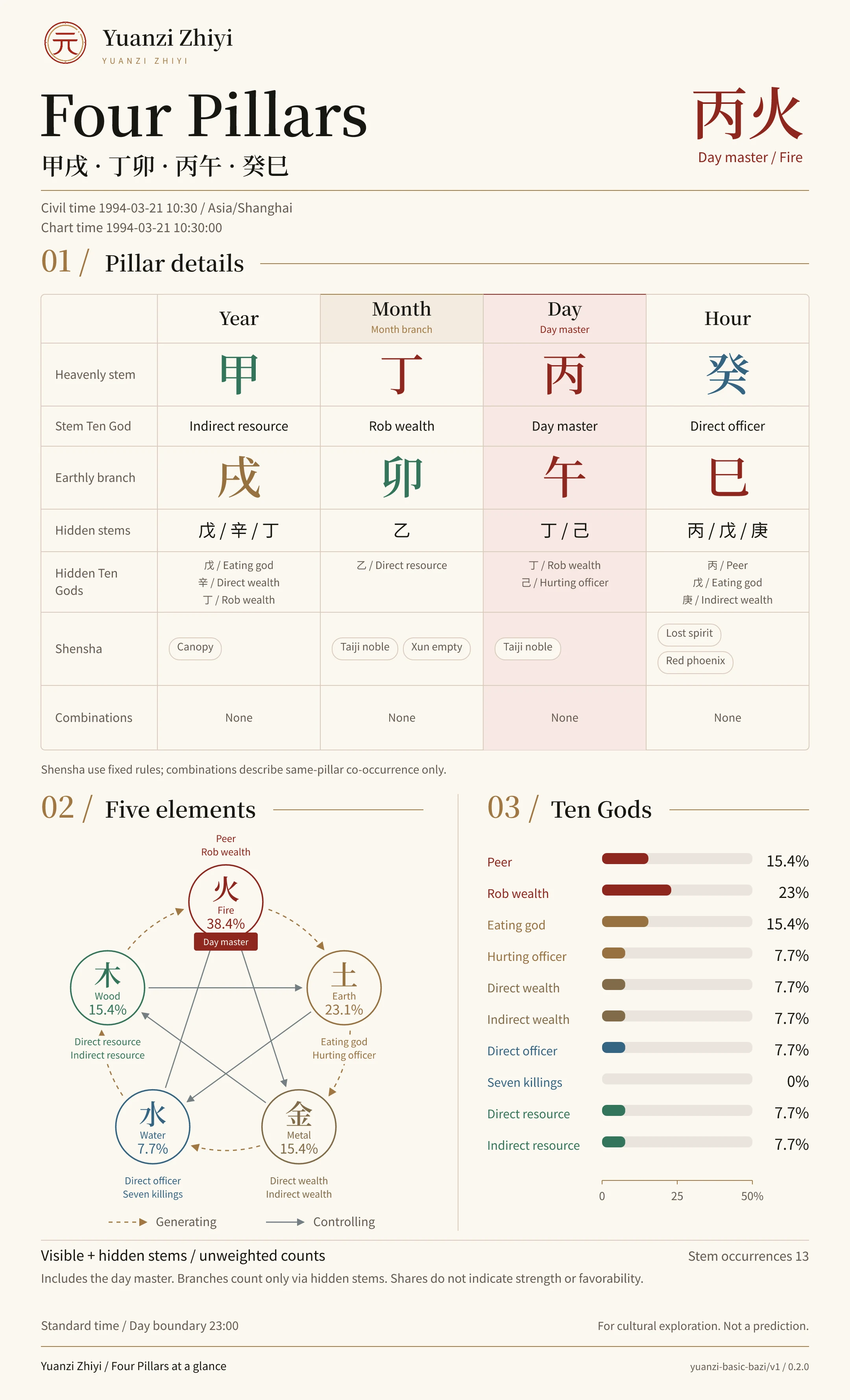
Second fictional chart: Jia-Xu, Ding-Mao, Bing-Wu, Gui-Si. Four Pillars table, Five-element composition, Ten Gods shares
Second fictional chartView full-size image
  1. Four Pillars table

    Yi Wood / Bing Fire

    The first chart has a Yi Wood day master; the second has Bing Fire. Compare each person’s stated need for budgets and breathing room rather than assigning motives from a day master.

  2. Five-element composition

    Earth, Water 33.3% / Fire 38.4%

    Earth and Water are each 33.3% in the first chart; Fire is 38.4% in the second. Make the structural contrast visible, then separately agree fixed costs and personal freedom.

  3. Ten Gods shares

    Resource 26.7% / Rob wealth 23%

    Direct resource is 26.7% in the first chart; Rob wealth is 23% in the second. These are reflection cues. The practical output is a shared-account rule, personal time and a review after 30 days.

Two charts, two perspectives on daily life

The example charts have Yi Wood and Bing Fire Day Masters. The report uses their elemental differences as an observation lens, then compares them with what you both say you need around money, plans and time alone. That gives the conversation a concrete place to begin.

Timing Traps That Escalate Friction

Bringing up budget rules late on Friday nights or right while paying a bill makes practical coordination sound like an audit, quickly turning solvable household logistics into unnecessary defensive pushback.

Put it into practice

A Warm Opener to Start the House-Rules Talk

Let's grab coffee this Sunday and spend thirty minutes setting up an easy rhythm before we move in. I don't want to turn our weekends into a timetable—just put rent and groceries on autopilot so our free time and personal spending stay relaxed, then tweak things together after month one.
  1. One 40-Minute Cafe Alignment Talk

    Meet at a relaxed Sunday cafe for forty minutes before moving day to settle two basics: both partners fund one fixed monthly account for rent, utilities, and groceries, while personal spending stays completely autonomous without receipts.

  2. First-Month Trial Pact and Check-In

    Frame your first thirty days together as a low-pressure trial: plan one shared half-day on Saturdays, leave Sundays completely unscheduled, and review what felt comfortable over dinner at day thirty without keeping score.

What you take away

  • Comparison of everyday pacing and friction points
  • Structured forty-minute conversation guide before moving in
  • Trial living agreement with thirty-day review guide